FG, World Bank Engage on New Country Partnership Framework to Boost Jobs, Human Capital, and Local Development
 managarciya

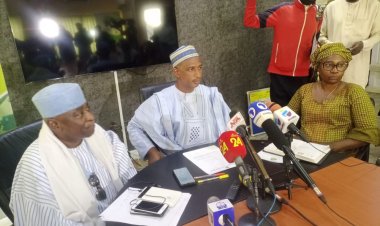
The Federal Ministry of Budget and Economic Planning on Monday, December 8, 2025, hosted a high-level consultative meeting with the World Bank Group on Nigeria’s proposed New Country Partnership Framework (CPF), aimed at driving inclusive growth, job creation, and private sector-led development across the nation.
Welcoming the delegation, the Minister of Budget and Economic Planning, Sen. Abubakar Atiku Bagudu, described the CPF as a “golden opportunity” to align with Nigeria’s 2026–2030 development plan. He emphasized that the Ministry has invested in “strong brainstorming sessions” to interrogate Nigeria’s cooperative federalism, revealing opportunities for deeper collaboration across federal, state, and local governments.
He underscored that decentralizing planning and mapping economic opportunities to states, local governments, and wards will enhance outcomes, particularly in creating jobs, increasing incomes, and supporting human capital development.
Minister Bagudu highlighted the Ministry’s vision to use federal transfers to “derisk” private capital, ensuring that government investments in renewable energy, agriculture, and infrastructure catalyze additional private sector participation. He noted that many federal programs, including the Renewed Hope Infrastructure Fund and the ward-based development plan, are designed to encourage private sector engagement and generate tangible economic opportunities at the grassroots.
“Our renewed hope ward-based development plan is designed to ensure that governance structures at the ward level are fully engaged in identifying economic opportunities and efficiently utilizing resources,” he said. “We are determined to transform potential sources of conflict into avenues for growth, while supporting climate resilience and sustainable livelihoods for our communities. For example, livestock, fisheries, and agriculture can be sources of income rather than conflict if properly managed and integrated into local development programs.”
The Minister further highlighted the Ministry’s efforts to enhance transparency, optimize revenue allocation, and work with all three tiers of government to guarantee “irreducible minimum” investments in infrastructure and security. He emphasized the importance of leveraging domestic capital markets to channel idle savings into productive investments, ensuring that public and private resources are maximized for economic growth.
World Bank Country Director for Nigeria , Mr. Mathew Verghis, reaffirmed the Bank’s commitment to Nigeria, noting that the new CPF will focus on job creation, private capital mobilization, human capital development, and resilience. He emphasized the strategy of scaling up state-focused projects and leveraging private sector engagement to double the impact of initiatives in energy, broadband, agriculture, and small and medium enterprises.
In conclusion,Senator Bagudu and Mr. Verghis reaffirmed that the CPF represents a transformative approach to national development. By combining decentralized planning, enhanced human capital, private sector mobilization, and inclusive governance, the framework is set to deliver measurable results for Nigerians. The Ministry pledged its continued commitment to ensuring that the CPF strengthens local development, maximizes resource efficiency, and supports the nation’s long-term economic and social objectives.